

There is someone in your office who has survived every layoff, every restructuring, every toxic manager, and every political realignment your organization has produced in the last decade.
They are not the most talented person in the room. They are not the loudest, and they are not even the most liked though they are liked well enough by everyone to never be targeted. What they are, specifically, is unfindable. Strategically unfindable.
While you have been defending ideas in leadership presentations, spending political capital on decisions you believed were correct, and accumulating the ordinary friction that comes from doing actual work this person has been executing a precision strategy that most professionals never recognize until they have already lost significant ground to it. Organizational psychologists document this behavioral profile under the clinical framework of Machiavellianism not the theatrical villain, but the cold methodology.
The core weapon is deceptively simple: strategic neutrality. In the modern knowledge-economy workplace, strategic neutrality is not a soft skill. It is a structural competitive advantage that compounds, quietly, over years. And the professionals most systematically harmed by it are almost always the ones working hardest.
The question is not whether this person exists in your organization. They do. The question is whether you have already been outmanoeuvred and whether, if you had been, you would know.
Key Takeaways
- The office shapeshifter does not win political fights. They ensure they are never in them and that distinction is the entire architecture of their advantage.
- Strategic neutrality is not the absence of politics. It is the most sophisticated political strategy available inside low-accountability organizations.
- Promotion decisions are risk assessments disguised as performance evaluations. A candidate with no visible enemies represents zero inherited conflict for the decision-maker above them.
- The shapeshifter’s power is structurally dependent on organizational ambiguity. Their model collapses the moment they are required to commit to a documented position.
- Every time you take a visible stance, the gap between your political capital and theirs widens even when you win the argument. Especially when you win.
- High performers are disproportionately vulnerable to this dynamic because their visible output creates accountability that the shapeshifter deliberately withholds.
- The counter-strategy is not confrontation. It is intellectual ownership establishing your analytical frameworks before outcomes exist to be claimed by someone else.
- The uncomfortable question this archetype forces: at what point does learned self-protection become indistinguishable from calculated opportunism?
The Political Cost Nobody Warns You About
Every visible position you take in a meeting generates what organizational theorists call political exposure a trail of documented decisions, defended priorities, and publicly staked claims. In healthy organizations, that exposure is a feature. Competence is rewarded. Accountability is valued. Position-taking is how leaders get made.
But in the environments where most careers actually unfold large organizations with diffuse accountability structures, opaque incentive systems, and leadership that turns over every two to three years political exposure functions differently. It accumulates as liability. The shapeshifter understood this before you did, and they structured their career accordingly.
They arrive in meetings and ask clarifying questions without advancing a position. They synthesize competing perspectives without endorsing either. They send emails that say things like “Let’s ensure we align with leadership’s broader vision” which sounds collaborative, reads as productive, and commits to absolutely nothing.
Consider how a corporate project dies. There is a post-mortem. Emails are audited. High performers find their names attached to flawed timelines, suboptimal strategies, and documented misjudgments the natural residue of having made real decisions under genuine uncertainty. The shapeshifter’s only contribution to the project file was a series of open-ended calendar invites and messages containing variations of the alignment phrase above. The corporate guillotine drops. The blade passes through them cleanly.
Over two years, while you have been spending capital on work that matters, they have been preserving theirs. The asymmetry is structural. And by the time it becomes visible, it has already determined the outcome of your next promotion cycle.
Here is the mechanism underneath: most organizations are not evaluation systems. They are social systems that run evaluation processes occasionally, inconsistently, and under significant political influence. In social systems, the absence of enemies reads as safety. Political safety is what executives are actually purchasing when they make succession decisions.
Three Mythologies That Already Mapped This Person

Three mythological traditions separated by geography, language, and centuries independently produced the same character. That convergence is not coincidence. It is documentation.
Norse mythology gave us Loki a figure who sits with the gods at Asgard but drinks with the giants. His power is not force and not authority. It is the accumulated trust of every faction that believes he belongs to them. The gods kept Loki close not despite the fact that he was a liability, but because of it. Whenever institutional crisis struck, Loki was the only figure fluid enough to negotiate with the enemy. He had made himself the indispensable fixer for the structural disasters his own calculated silence had allowed to develop. That is a specific kind of corporate genius.
The Akan tradition gave us Anansi the spider deity who is never the strongest creature in any story and never needs to be. Anansi’s power is narrative control. The creature who decides which version of events becomes the official record does not need to win fights. It needs to be present when the record is written. In your organization right now, there is someone who is always present when organizational records are written. Someone whose name appears in summaries without appearing in decisions.
Then there is Proteus, the Greek sea god who changes shape to evade capture. Every time you attempt to pin him down, he transforms. The only way to extract a straight answer from Proteus is to hold him physically still to grip him and refuse to release until he stops transforming. The myth encoded the critical insight two thousand years before the modern performance review existed: Proteus cannot be trapped by force. Only by stillness.
In the contemporary office, nobody holds the shapeshifter still. Meetings end before positions are documented. Decisions are made in the verbal register, where accountability evaporates. And the shapeshifter moves on to the next room before the record catches up to them.
What most people misread about this archetype: they assume it requires active deception. It rarely does. The shapeshifter does not usually lie. They simply never commit and in environments where commitment is not required, that distinction stops mattering.
The Anatomy of a Zero-Fingerprint Career

Externally, the shapeshifter is demonstrably useful. They appear in every room that matters. Your colleagues describe them as “good at navigating politics.” What they are actually describing is a precise optimization ratio: maximum visibility, minimum accountability. Maximum visibility because ambiguity is only valuable to someone who can observe the outcome. Minimum accountability because the power only persists while no permanent record exists.
What this produces internally inside the high performers who work alongside them is harder to name. There is a specific cognitive fatigue involved. You know something is structurally wrong. You cannot identify what they did. Because they have not done anything. You have taken positions. You have defended priorities. You have accumulated the ordinary friction that leadership actually produces. They have not. And every time you stake a claim, the gap between your political balance sheets widens.
The high performer’s instinct is to respond with better work sharper analysis, cleaner presentations, more compelling evidence. But the asymmetry is not a performance gap. It is a political capital gap. And more output does not close a capital gap. In low-accountability environments, more output widens it, because every additional deliverable is an additional surface area for accountability.
Why are high performers disproportionately vulnerable to this dynamic? Because visibility which performance requires is precisely what the shapeshifter strategically withholds. You are, by the nature of your work, doing the thing that makes you exploitable.
Why Promotions Structurally Favor the Shapeshifter
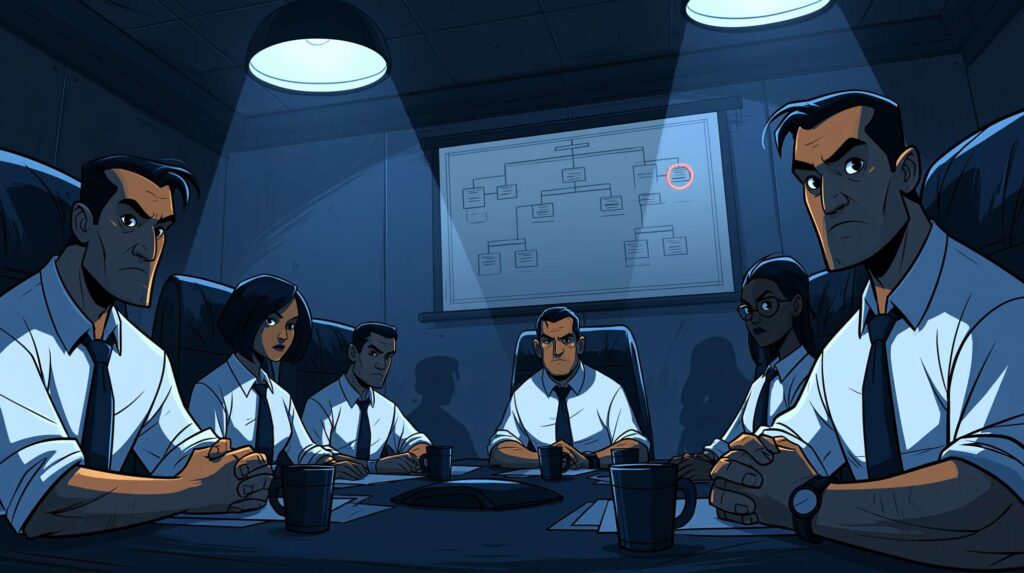
The promotion decision your organization is about to make is not fundamentally about performance metrics. It is about political risk assessment specifically, the question of how much inherited conflict the decision-maker above you is willing to absorb.
When an executive elevates a high performer who has taken visible positions and defended contested priorities, they inherit that professional’s enemies. Their unresolved conflicts. Their accumulated political debt. In many organizations, that inheritance is the real cost of a promotion decision, and executives with long institutional memories know it.
The shapeshifter has no enemies. No visible conflicts. No documented controversies. From where the decision-maker sits, they represent a clean political slate which, in ambiguous organizational environments, is the closest thing to a guarantee.
This is not conspiracy. It is a predictable output of a system that was never actually designed to optimize for external performance. It was designed to optimize for internal stability. And in systems optimized for internal stability, zero-conflict profiles win a structural advantage that talent and output cannot reliably overcome.
Why do organizations quietly punish certainty while rewarding ambiguity? Why do competent people accidentally become political threats? These are not rhetorical questions. They are the precise questions the next section of the video answers and the answers are more uncomfortable than the diagnosis.
The Three Diagnostic Tests
Before you act, confirm. Misidentifying a shapeshifter and moving against a normal colleague is both unjust and strategically catastrophic. Conflict with a genuine shapeshifter does not expose them. It exposes you. They are precisely optimized for that dynamic: you challenge them, they become the neutral party, and the conflict registers on your record and not theirs.
Run three tests instead.
Test One: The Position Test. Recall the last three major organizational decisions a budget cut, a restructuring, a strategy shift. Now ask: what position did this person publicly advocate? Not what they whispered privately in a hallway debrief. What did they commit to on record, with witnesses, in a forum where accountability was possible? If the answer is a blank space across three significant decisions over a meaningful period of time, that is your data. Absence of documented position is not neutrality. It is a calculated architecture.
Test Two: The Enemy Audit. Consider their full tenure across multiple leadership transitions and restructurings the organizational moments when real sides were genuinely chosen. Now ask: who sincerely dislikes them? Not surface irritation. Actual, motivated opposition. Natural likability produces friction over time. No professional survives years of high-conflict organizational environments without accumulating some genuine opposition unless the neutrality is being actively managed. If the answer approaches zero across years of contested environments, the signature is there.
Test Three: The Room Mapping Test. When a major decision is made in a room you were not invited to was this person there? Track this deliberately over one quarter across five significant decisions. If they are consistently present for consequential decisions that happen adjacent to your work but without your participation, they are not neutral. They are positioned. Positioning and neutrality are mutually exclusive.
The Counter-Strategy: Intellectual Ownership Before the Outcome Exists
The shapeshifter’s model requires one specific thing from the professionals around them: that those professionals keep spending political capital while they save theirs. The counter-strategy does not attempt to match their discipline for neutrality. It does something they cannot replicate.
Visibility engineering specifically, establishing intellectual ownership at the moment of creation rather than the moment of vindication.
In practice, this works through three specific behaviors.
First: document your analytical framework in writing before the outcome is clear. Not bureaucratically, not as a defensive paper trail. Briefly, specifically, and in the appropriate forum a 1:1 note, a project document, a Slack thread. The goal is to attach your name to a framework at the point of intellectual creation. The shapeshifter’s model depends on positioning themselves adjacent to successful outcomes after those outcomes are confirmed. Close that window before the outcome exists to be claimed.
Second: name your position explicitly in your next 1:1. On a contested question. Not aggressively specifically. Something in the register of: “My read on this is X. Here is the framework I am using to hold that position.” This is the single move the shapeshifter will never replicate, because replicating it requires committing and documented commitment is the structural threat to their entire model.
Third: compete for interpretive authority, not neutral territory. Most high performers instinctively fight for the outcome itself. The shapeshifter fights for the interpretation of the outcome which is where the political credit actually lives. Build your frameworks publicly enough, early enough, that appropriating them would require visibly reproducing your thinking under your name. The shapeshifter cannot claim what already carries your intellectual signature.
None of this requires confrontation. It requires a different relationship with visibility treating it as territory to be staked, not a byproduct of performance to be earned later.
The Question That Has No Easy Answer
There is a version of this analysis that ends here: protocol deployed, shapeshifter identified, Monday morning navigated.
That version is incomplete.
Research on organizational behavior documents something that high performers in genuinely political environments quietly already know: in low-accountability organizations, taking visible positions is punished more reliably than strategic ambiguity is rewarded. The professional who spends capital on principle and loses does not just lose that battle. They lose the capacity to spend on the next one. After enough of those cycles, the behavioral logic of the shapeshifter stops looking like opportunism. It starts looking like rational adaptation to an irrational system.
Which forces the question worth sitting with before Monday arrives: at what point does a professional who learned to protect themselves become indistinguishable from one who was always optimizing for their own advantage?
Is that difference visible to your organization? To your manager? To yourself?
The shapeshifter has no answer to that question. They never developed one. That absence the inability to account for what they are still willing to commit to is ultimately the only diagnostic that matters.
And if you can still answer it, you already know which one of you is which.
Key Moments From the Video
- 00:00 – The Weapon of Strategic Neutrality
- 00:42 – The Roots of Machiavellianism
- 01:08 – The Mirror: Ancient Archetypes
- 01:16 – Loki: The Indispensable Crisis Negotiator
- 01:59 – Anansi: Controlling the Official Record
- 02:21 – Proteus: The Fluid Shapeshifter
- 03:06 – The Anatomy: Maximum Visibility, Minimum Accountability
- 03:38 – Low Fingerprint Density
- 04:30 – The Toll of Exposure Asymmetry
- 05:20 – Why Promotion Systems Favor Zero Risk
- 06:39 – THE SHAPESHIFTER RECOGNITION PROTOCOL
- 07:06 – Test 1: The Position Test
- 07:39 – Test 2: The Enemy Audit
- 08:18 – Test 3: The Room Mapping Test
- 08:43 – Counter-Strategy: Visibility Engineering
- 09:57 – The Open Loop: Rational Adaptation?
- 11:26 – Outro: The Scapegoat & The Loyalty Trap
Frequently Asked Questions
What is an office shapeshifter, and how is it different from general office politics?
An office shapeshifter is a professional who navigates organizational politics through deliberate strategic neutrality cultivating relationships across competing factions by systematically avoiding documented commitments. Unlike ordinary political behavior, which involves choosing sides and spending capital, the shapeshifter’s model involves never choosing sides at all. This behavioral profile is documented within the Machiavellianism framework in organizational and social psychology and produces a specific, identifiable career signature: high visibility, near-zero accountability fingerprint.
How do I identify a Machiavellian colleague without misattributing ordinary professionalism?
The most reliable diagnostic is the absence of documented positions across genuinely consequential decisions over an extended period. Run three tests: the Position Test (what did they publicly commit to across the last three major decisions?), the Enemy Audit (who has genuine opposition to them after years of high-conflict organizational environments?), and the Room Mapping Test (are they consistently present in rooms where decisions adjacent to your work are made, without your inclusion?). Any single test is insufficient. The pattern across all three is the signal.
Why does strategic neutrality produce promotions in organizations that claim to reward performance?
Promotion decisions in most large organizations function as political risk assessments, not performance evaluations. When an executive elevates a candidate, they inherit that candidate’s existing conflicts and political debts. Candidates with no visible enemies represent zero inherited risk. In ambiguous organizational environments optimized for internal stability rather than external performance, zero-conflict profiles carry a structural advantage that output and talent cannot reliably override.
What is the most effective counter-strategy when a colleague is appropriating your work or ideas?
Direct confrontation with a shapeshifter typically backfires it positions you as the source of conflict and them as the neutral party observing it. The effective counter is intellectual ownership established before outcomes are confirmed: document your analytical frameworks and positions in writing at the moment of creation, not after vindication. Name your positions explicitly in appropriate forums. Compete for interpretive authority the right to define what an outcome means rather than fighting for credit after the fact.
Is strategic neutrality always a form of bad faith, or can it be a legitimate adaptive response?
Not categorically. Research on organizational behavior distinguishes between deliberate, systematic ambiguity deployed to accumulate political capital (the Machiavellian model) and learned self-protection developed in response to organizations that genuinely punish visible commitment. The uncomfortable analytical conclusion is that, from the outside, these two behavioral profiles may be indistinguishable which is both the defense the shapeshifter would offer and the most honest structural critique of organizations that produce the conditions where the distinction stops mattering.
What is “exposure asymmetry” and why does it compound over time?
Exposure asymmetry describes the structural gap that develops between professionals who produce visible output documented decisions, defended priorities, public positions and those who do not. Each visible output generates political exposure that, in low-accountability environments, accumulates as liability rather than credit. The shapeshifter, producing no equivalent visible output, accumulates no corresponding liability. Over two or more years, this creates a political capital differential that additional performance cannot close because more output produces more exposure, widening the gap further.
Watch Next: The Loyal Lieutenant Why Organizations Exploit the People Actually Doing the Work
If you recognized the shapeshifter in this analysis, the next question is more uncomfortable: who is being systematically exploited by them?
The shapeshifter’s model requires a counterpart the professional who keeps spending political capital so that others never have to. The figure who absorbs institutional risk, defends unpopular positions, and remains visibly loyal to a leader or strategy while everyone with better political instincts quietly distances themselves. In organizational terms, this is not a minor supporting character. This is frequently the person the work actually depends on.
The mythological archives have documented this figure with unusual precision. Patroclus, who went to battle wearing Achilles’ armor so that the organizational symbol could be preserved while the actual talent stayed safe. Karna, who fought for a structurally flawed commander out of a loyalty that was genuine, noble, and professionally fatal. Bedivere, the last knight standing loyal to a collapsing institution long after everyone with functional political instincts had already negotiated their exit.
These are not figures of naivety. They are the people in your organization who are actually doing the work who hold the institutional knowledge, who absorb the relational friction, who build the real capability that organizational performance depends on. And they are being exploited by the same structural conditions that reward the shapeshifter.
The next Mythos & Mortals video maps the psychological mechanics of loyal lieutenant exploitation: why loyalty becomes a liability in political environments, how organizations manufacture devotion and then weaponize it, and the specific moment when commitment stops being a professional virtue and starts being a structural vulnerability.
Watch it before your next Monday morning. You will recognize someone in it immediately. The harder question is whether that someone is you.
Other Interesting Posts
- The Office Shapeshifter: Why the Most Dangerous Person in Your Workplace Has Never Lost a Political Fight
- The Guardian Archetype: How Ancient Tamil Mythology Holds the Blueprint for Surviving Toxic Workplaces
- The Tea Horse Road: What the World’s Most Brutal Trade Route Reveals About Human Endurance, Suffering, and the Limits of What a Body Can Bear
- The Rise and Fall of Mesopotamia: How the World’s First Civilisation Still Shapes How We Build and How We Collapse
- Six Gods Who Explain Every Toxic Workplace And the One Who Survives Them All
Mythos & Mortals publishes long-form analysis at the intersection of ancient mythology, depth psychology, and modern organizational behavior. Ancient blueprints. Modern workplaces. Decoding the corporate condition.