
Key Takeaways
- Hercules exposes the “Lone Genius” trap: the very excellence that earns you leadership is the first thing that must die when you actually lead.
- Lord Rama’s Dharma-driven servant leadership predates every Harvard Business Review framework by three thousand years and still outperforms them.
- Odin’s self-sacrifice at Mimir’s Well is the most honest metaphor for strategic vision ever recorded: foresight always costs you something you currently value.
- Shango’s thunder reveals the Authoritative Founder Paradox the same energy that builds a culture will destroy it if it never learns to become weather instead of a storm.
- Itzamná makes the case that institutional knowledge is the most undervalued competitive asset in modern organizations, and most are hemorrhaging it daily.
- Murugan’s six-faced awareness maps directly onto multi-directional competitive strategy and the Tamil concept of Aram connects ethical competition to long-term market dominance.
- Huitzilopochtli is both the most powerful and most dangerous archetype: missionary leadership that forgets its people is not leadership. It’s a furnace.
Key Moments in the Video
- 0:00 The Lone Genius Fallacy
- 0:55 Hercules (Greece): Breaking the High-Performer Bottleneck
- 2:45 Lord Rama (India): Servant Leadership and the Power of Dharma
- 4:50 Odin (Norse): The “Price of Knowing” and Strategic Foresight
- 6:35 Shango (Yoruba): The Authoritative Founder’s Paradox
- 8:15 Itzamná (Maya): Wisdom vs. Strength: Building the Codex
- 10:00 Murugan (Tamil): Competing with Honor as your Moat
- 11:50 Huitzilopochtli (Aztec): Mission Clarity vs. Burnout
- 13:15 The Audit: Which Archetype Are You Actually?
Why Leadership Archetypes From Mythology Are More Relevant Than Anything in Your Management Handbook
Leadership archetypes from mythology aren’t relics of pre-scientific thinking. They’re compressed data thousands of years of pattern recognition about human behavior, encoded in stories sturdy enough to survive civilizational collapse, translation, and centuries of retelling. And the reason they survived is precisely because they were true.
Here’s the thing nobody puts in the onboarding deck: the moment you receive a team, the game changes completely. The skills that made you visible your ability to produce, to solve, to outperform those become your liability. You’ve been operating as a high-output individual. Now you’re supposed to be a force multiplier for other people’s output. That is not an incremental skill upgrade. That is a different psychological operating system.
The extraordinary thing is that seven civilizations, working entirely independently across thousands of miles and centuries, already mapped this transition. In gods, warriors, scholars, and storm-deities, they left us a diagnostic framework more precise than anything the leadership development industry has built since.
This piece runs through all seven. It goes deeper than the mythology. It connects each archetype to modern psychological frameworks, real organizational failures and triumphs, and something most of these analyses miss entirely: the shadow side of each archetype the way each divine quality, left unchecked, becomes exactly the problem it was meant to solve.
Let’s begin.
What Does Hercules Reveal About the Hidden Cost of Being the Best Person in the Room?
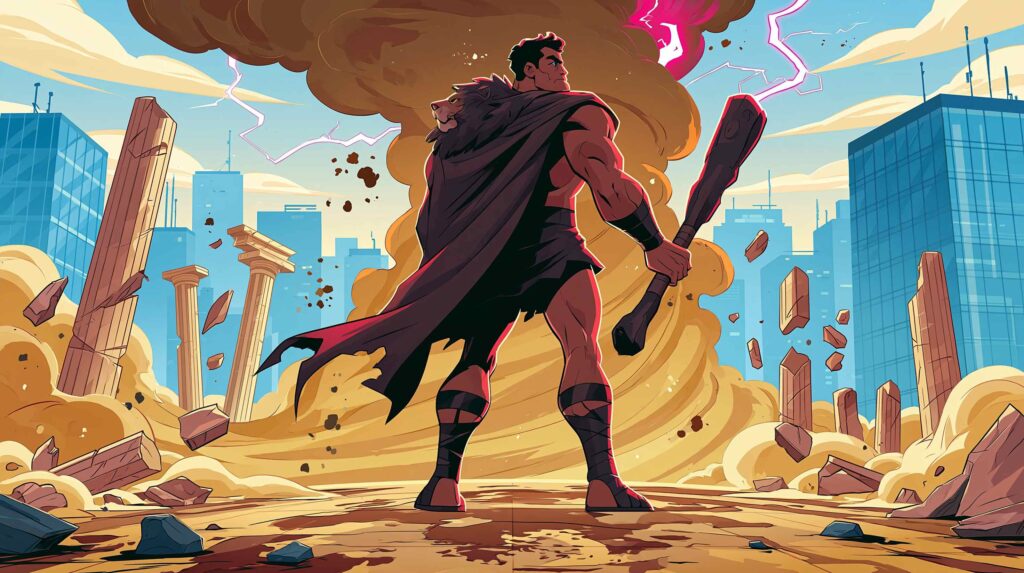
The Greeks called him Heracles Monoikos. The Lone Dweller. Not as a compliment. As a clinical observation.
By every individual performance metric available to a Bronze Age civilization, Hercules was untouchable. He killed the Nemean Lion with his bare hands. He cleaned decades of biological catastrophe from the Augean Stables by redirecting two rivers in a single day that’s not just strength, that’s lateral problem-solving at a scale that would get you promoted in any organization on earth. His labors read like a decade of performance reviews where every box is checked and every target is exceeded.
If Hercules applied to your company, your recruiters would fight over the offer letter.
But. Here is what the highlight reel omits.
Hercules was a structural liability the moment he was placed in a phalanx.
The Greek military phalanx was not built for excellence. It was built for synchronization. Eight to sixteen rows of soldiers with shields locked, spears extended, moving as a single organism. It didn’t reward the strongest man it rewarded the man who could subordinate his instincts to the collective rhythm. The phalanx ran on trust. The moment one soldier broke left or right based on individual judgment, he created a gap. A gap becomes a breach. A breach becomes a routing.
Hercules only knew one direction: forward. Alone.
The Jungian Shadow of the Hero Archetype
Carl Jung identified the Hero as one of the most fundamental archetypes in the human psyche the principle of courage, capability, and the conquest of obstacles. But every Jungian archetype carries a Shadow: the distorted, unintegrated version of itself that emerges when the archetype is overexpressed.
The Shadow of the Hero archetype isn’t weakness or cowardice. That’s what most people assume. The Shadow of the Hero is ego inflation the unconscious belief that the hero’s individual capability is so essential that it supersedes the collective. In psychological terms: the hero becomes the dragon.
This is the Hercules manager. Not malicious. Not lazy. Often, genuinely, the most talented person on the team. But so unconsciously identified with their own capability that they cannot tolerate the slow, slightly imperfect, occasionally frustrating process of letting other people develop. So they take the task back. They fix it themselves. They answer the client email before the junior account manager gets a chance to. And with every rescue, they quietly confirm to their team: you are not capable enough to be trusted with this.
Teams stop growing. Individuals stop developing. The organization builds a single point of failure that wears a leadership title.
The Leadership Parallel: The Twelve Labors Were Never Solo Missions
Here is the detail that gets lost in every Hercules retelling: the Twelve Labors were not individual achievements. They were forced alliances. Hercules had to seek counsel from oracles, negotiate with kings, build temporary coalitions with beings far outside his area of strength. The myth wasn’t celebrating his muscles. It was documenting his education in the one thing raw capability cannot provide: the wisdom to operate within a system larger than yourself.
Your Hercules manager isn’t broken. They’re mid-labor. The question is whether they reach labor twelve before the team resigns.
Actionable diagnostic: Count how many times in the last month you completed a task that was on someone else’s plate. If the answer is more than twice, you’re not leading. You’re bottlenecking.
How Did Lord Rama Practice Servant Leadership 3,000 Years Before Harvard Business Review?
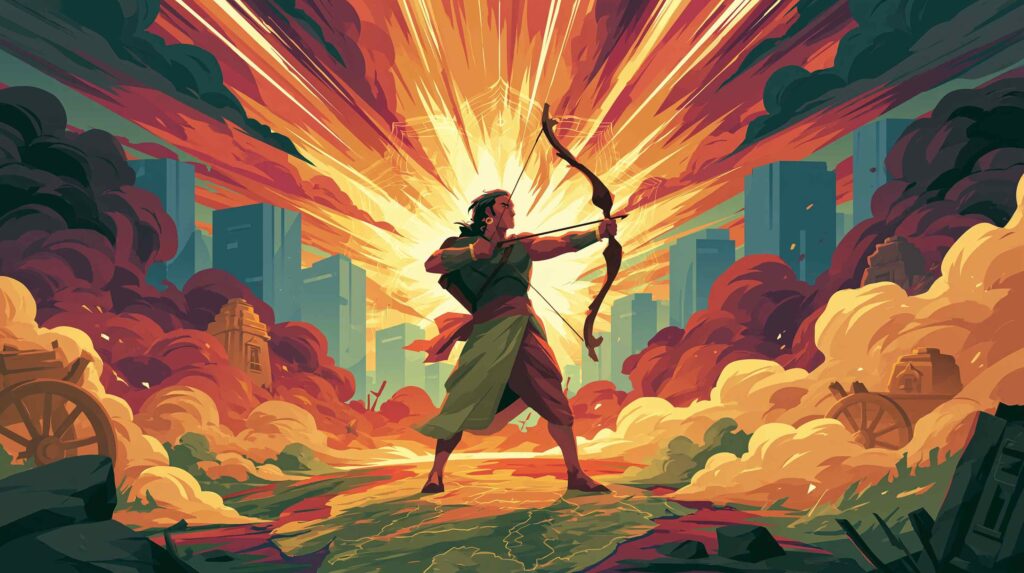
Cross the Aegean, travel east across the subcontinent, and arrive on the banks of the River Sarayu in ancient India. If Hercules is the problem statement, Lord Rama is the answered prayer.
The Ramayana describes him as Maryada Purushottam the supreme upholder of virtue. Seventh avatar of Vishnu. Ideal king. Ideal son. And his defining leadership act is the one that makes every ambition-forward professional genuinely uncomfortable to sit with.
When Rama is ordered into fourteen years of forest exile not for a crime, not for a strategic miscalculation, but because his father honored a political promise made to a jealous queen Rama accepts it. Immediately. Without litigation. Without a coalition of supporters lobbying for reversal. Without even what most of us would reach for first: the passive-aggressive compliance that says technically I’m doing what you asked, but I want everyone to know how wrong this is.
He calls it Dharma. Duty. The integrity of the system you serve is worth more than your comfort within it.
The Uncommon Connection: Dharma as “Secure Base” Leadership
Here’s a parallel that gets almost no attention in Western leadership writing: Lord Rama’s behavior maps almost perfectly onto John Bowlby’s Secure Base theory developed in the 1960s to describe attachment psychology, and later extended by researchers including George and West into organizational behavior.
The core insight of Secure Base theory is this: people perform at their highest level when they feel psychologically safe enough to take risks. The leader who creates that safety who demonstrates, through their own behavior, that the mission is stable even when conditions are brutal becomes a gravitational center that others organize around without being commanded to.
Rama’s acceptance of exile wasn’t passivity. It was a live demonstration, in the most costly possible terms, that his commitment to the integrity of the system was unconditional. It didn’t require favorable conditions. And that demonstration was magnetic in a way that orders, incentives, and org charts simply cannot replicate.
His brother Lakshmana followed him into the forest voluntarily. The monkey king Sugriva built an army for a man who hadn’t asked for one. These aren’t narrative flourishes. They’re descriptions of what happens to loyalty when a leader proves, under genuine personal cost, that they are not there for the position.
This is servant leadership. Pre-Harvard. Pre-LinkedIn. Pre-every conference keynote that cost your company four thousand dollars a seat and produced a twelve-point action plan that nobody looked at after the follow-up email chain died.
The Leadership Parallel: Loyalty You Didn’t Ask For Is the Only Kind Worth Having
The leader who subordinates personal recognition to the mission doesn’t lose influence. They multiply it. The distinction is between transactional authority which works only while the incentive structure holds and earned legitimacy which works especially when everything else is falling apart.
Satya Nadella’s transformation of Microsoft is the modern case study here. He arrived in 2014 to a company that had become internally predatory stack-ranked performance reviews had created a culture where individual success required someone else’s failure. He didn’t issue mandates about culture change. He handed his leadership team Carol Dweck’s Mindset, demonstrated through every public decision that the organization’s growth mattered more than his position, and waited. Three trillion dollars in market cap later, the Rama principle has a quarterly earnings citation.
Actionable diagnostic: When your team fails at something, whose problem does it become in the post-mortem? If the answer is theirs, you’re operating as a title-holder. If the answer is ours, you’re operating as Rama.
What Can Odin’s Sacrifice at Mimir’s Well Teach You About Your Organization’s Biggest Blind Spot?
Now travel north, past the warmth of India and the civility of Greece, into the unforgiving cold of Norse mythology.
Odin the Allfather, king of Asgard, god of wisdom and war arrived at Mimir’s Well. The primordial spring said to hold the water of all ages. Every pattern. Every cycle. Every inevitability that had ever played out in any civilization. Mimir, the guardian, named his price.
Not gold. Not military leverage. Not a political favor.
He wanted Odin’s eye.
And Odin the most powerful being in the Norse pantheon pressed his own eye into the water and surrendered it forever.
In return, he received Seiðr. Not simply knowledge. Foresight. The ability to perceive the architecture of future events before they materialized not by guessing, but by seeing the pattern beneath the pattern.
The Uncommon Connection: Kairos, Not Chronos
Classical Greek distinguished between two kinds of time. Chronos sequential, measurable time, the kind that moves in one direction and fills calendars. And Kairos the decisive moment, the qualitative rupture in time when the right action creates irreversible change. Most organizational decision-making operates entirely in Chronos time: quarterly cycles, annual reviews, five-year plans.
What Odin purchased at Mimir’s Well was the ability to perceive Kairos to identify not just what is happening but the specific moments when action becomes destiny. The capacity that most organizations are structurally incapable of, because acting on Kairos almost always requires paying in Chronos security.
Kodak’s engineers invented digital photography in 1975. The patent exists. They had the technology. They shelved it consciously, deliberately to protect a film revenue stream that was still generating comfortable Chronos-time returns. By the time digital became undeniable, the Kairos moment had been in the past for two decades. They filed for bankruptcy in 2012.
In 2000, Blockbuster was offered the chance to acquire Netflix for $50 million. The meeting is documented. The Blockbuster executive reportedly laughed. That laugh was an eye pressed into no well in exchange for nothing.
Reed Hastings at Netflix paid the price. When streaming became technically viable, he spun out the DVD business into a separate brand (Qwikster rest in peace), let it die on its own timeline, and went all-in on streaming. The comfortable assumption that the DVD subscription model had years of runway left was the eye. He pressed it. He can see now.
The Jungian Angle: The Shadow of Certainty
Jung’s concept of enantiodromia the tendency of things to transform into their opposite when carried to an extreme applies directly here. The certainty that made an organization dominant eventually becomes the rigidity that makes it brittle. The eye you’re most proud of is often the one most urgently in need of sacrifice.
The most dangerous sentence in any strategy meeting is: “We’ve always done it this way, and it’s always worked.” That sentence is an eye. It is costing you Mimir’s water every day you don’t press it.
Actionable diagnostic: Name the one assumption your organization is protecting that, if wrong, would fundamentally alter your strategic direction. Now ask: when did you last seriously test whether it’s still true?
How Does Shango Explain Why the Most Powerful Founders Often Destroy What They Built?
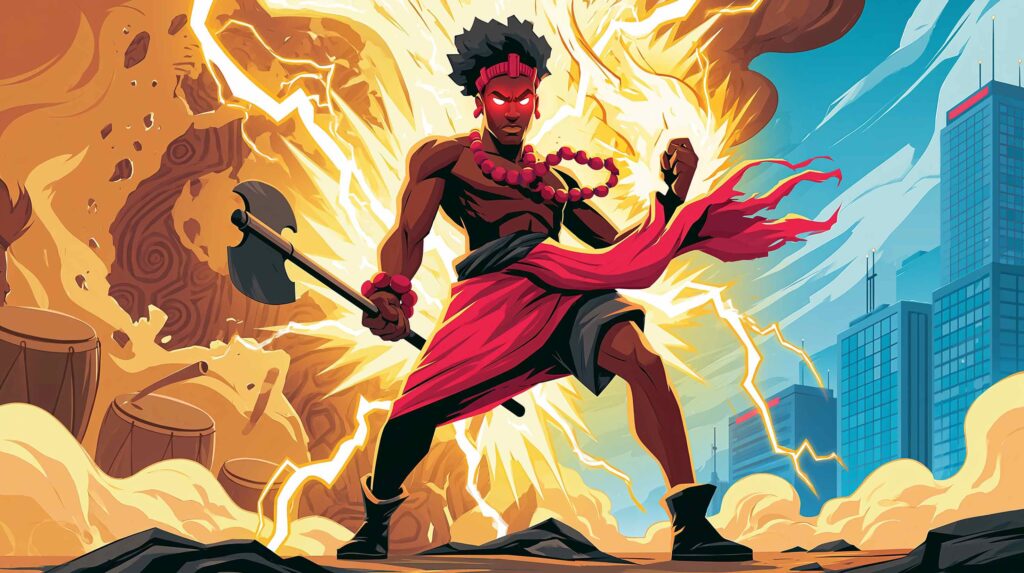
Three archetypes in. Three civilizations. And we still haven’t reached the thunder.
Shango. Fourth king of the Oyo Empire. Yoruba god of thunder, lightning, and justice. Warrior and dancer. The absolute, undeniable force of conviction given both human and divine form. His symbol is the Oshe the double-headed axe representing the dual power of authority: the right to establish order and the power to enforce it, simultaneously, with the same instrument.
When Shango entered a space, silence followed. Not the silence of fear the silence of recognition. His conviction was so total, so perfectly undiluted, that it became atmospheric. People around him operated in the certainty field he generated. They didn’t ask whether the mission was achievable; they couldn’t, because Shango had already made ambiguity structurally uncomfortable.
He was a conviction carrier.
Every organization that has ever scaled from zero to something significant had a Shango in its founding chapter. The person whose certainty about the vision pulled others across ground that, rationally assessed, should have been impossible.
Steve Jobs in a black turtleneck. Not just selling a product but delivering a cosmic pronouncement about what this device would do to human experience and meaning it at a level that bypassed skepticism entirely. Elon Musk sleeping on the Tesla factory floor during the Model 3 production crisis, personally welding components, dragging an entire organization through an impossible timeline by sheer gravitational force of belief. The early Airbnb founders, photographing strangers’ apartments with a rented wide-angle lens, refusing despite every investor’s laughter to accept that their model wasn’t a real business.
That is thunder. Real, necessary, civilization-building thunder.
The Jungian Angle: When the Ruler Becomes the Tyrant
In Jungian psychology, the Ruler is one of the twelve core archetypes the principle that creates order, establishes systems, and takes sovereign responsibility for outcomes. Its Shadow is the Tyrant: the Ruler who, having built the castle, can no longer distinguish between his authority and the institution itself. Who treats every challenge to his methods as a challenge to the mission. Who mistakes his certainty for everyone else’s mandate.
The Tyrant isn’t more powerful than the Ruler. He is the Ruler, unable to grow.
And this is precisely what Shango’s myth encodes. His thunderous authority, unchecked, untempered by the distributed governance that a scaled empire requires struck his own palace. The thunder turned against the structure it had built.
Travis Kalanick built Uber with exactly the conviction Shango represents. The culture he created relentlessly competitive, bottom-line aggressive, rules as obstacles rather than structures was precisely what Uber needed to disrupt a regulated industry that had grown complacent. And then the same culture became the reason a dozen senior executives resigned in a single year, a sexual harassment crisis consumed the company’s public identity, and the board removed him from the company he founded.
The thunder was real. The palace had to be rebuilt.
The Leadership Parallel: Weather vs. Storm
There’s a specific moment in every scaling organization’s life where this transition needs to happen, and almost nobody announces it. The organization needs to move from storm to weather from the electric intensity of conviction-driven founding culture to the consistent, reliable, distributed atmospheric system that people can actually plan around.
The founders who navigate it become Tim Cook. The ones who don’t become a cautionary case study in a business school elective about leadership failure.
Actionable diagnostic: When was the last time someone on your team disagreed with you in a meeting, and it changed the outcome? If you can’t answer that, you might be living in Shango’s palace.
What Did the Ancient Maya Understand About Institutional Knowledge That Your Organization Hasn’t?
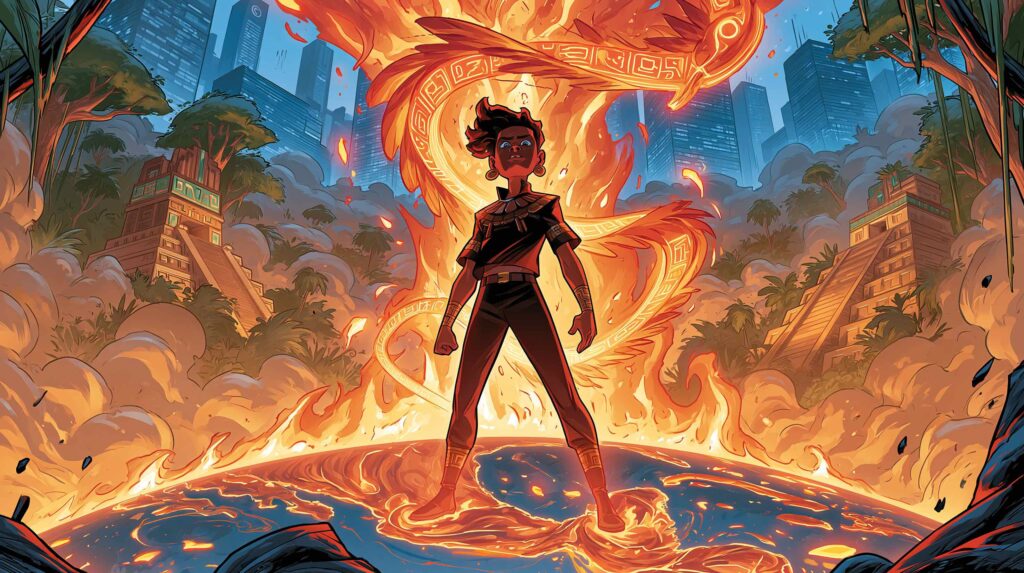
Leave the battlefield. We’re going somewhere more dangerous in a modern context: the library.
Itzamná the supreme deity of the ancient Maya was not a warrior. He invented writing. He codified the calendar. He founded the healing arts. He created the fundamental intellectual infrastructure of Maya civilization.
And here is the detail that stops me every time I look at it: the Maya, when they imagined this god, didn’t give him youth, muscle, or martial authority. They depicted him as an elderly, toothless scholar, surrounded by codices. They placed their greatest intellectual figure at the literal apex of the divine hierarchy above the war gods, above the rain gods, above the deities of agriculture and fertility and imagined him as a very old man who had lived long enough to have actually earned the authority to record what he knew.
That is not an aesthetic choice. That is a statement of civilizational values.
The Uncommon Connection: Ajaw, Knowledge Debt, and the Compounding Cost of Organizational Amnesia
The Maya concept of Ajaw often translated as “lord” didn’t simply mean military or political ruler. An Ajaw was a keeper: a person whose authority derived from their custodianship of accumulated knowledge and their responsibility to transmit it forward. This is a fundamentally different theory of authority than the one most modern organizations operate on.
Most organizational hierarchies are built on the authority of capability what you can currently produce. Itzamná’s model was built on the authority of preservation what you have learned, codified, and made available to everyone who comes after you.
In software engineering, there’s a concept called technical debt the accumulated cost of shortcuts, undocumented decisions, and deferred refactoring that every codebase accumulates over time and eventually has to pay. Organizations accumulate an equivalent knowledge debt the growing cost of undocumented institutional intelligence. Every senior engineer who leaves without documentation is knowledge debt. Every exit interview that never happened is knowledge debt. Every post-mortem that wasn’t written is knowledge debt.
And knowledge debt compounds.
The Maya built a calendar more accurate than the Gregorian system introduced fifteen centuries later, because they had a systematic commitment to recording, validating, and transmitting what they learned across generations. They had codices. They had keepers of codices. They placed those keepers at the top of the hierarchy.
Amazon has the closest modern equivalent. Jeff Bezos’s insistence on six-page narrative memos written before any project begins, sometimes including a mock press release for a product that doesn’t exist yet is an attempt to force institutional thinking before institutional investment. The discipline of writing a working-backwards document creates a record that survives the people who made the decision. It is a codex practice, imported into a Seattle office park.
The Leadership Parallel: Your Shared Drive Is Not a Codex
Most organizations have a shared drive that functions as a digital archaeology site. Decks from three strategic cycles ago. Analyses written for contexts that no longer exist. Documents with file names like “Final_V3_REVISED_USE_THIS_ONE” dated from two years before the person who created them left the company.
That is not a codex. That is knowledge debt in storage.
A living codex is something specific: a system where accumulated organizational intelligence validated decisions, documented failures, tested hypotheses and their outcomes is organized, maintained, and distributed to the people who need it. Where the institutional memory of why a pricing model was adjusted, or why a market was exited, or why a technical architecture was chosen, survives the exit of any single person.
Your organization is only as intelligent as the system it has built to preserve what it knows.
Actionable diagnostic: If your three most senior people left tomorrow, what percentage of their institutional knowledge would survive the transition? If the answer is less than 40%, you’re living in a civilization without codices.
How Does Murugan’s Six-Faced Awareness Redefine What Ethical Competition Actually Means?
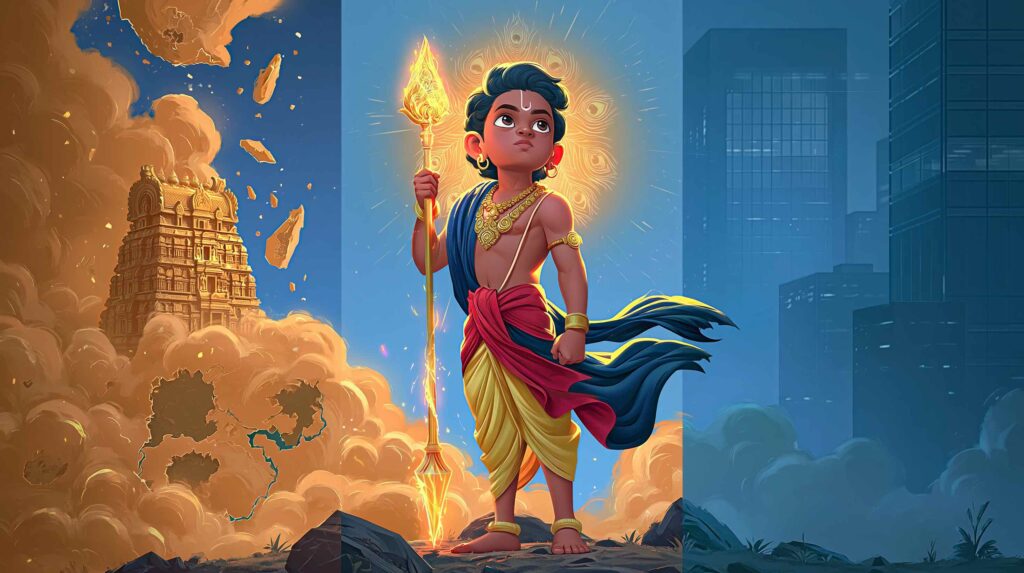
For anyone who has started to think ancient mythology is entirely about sacrifice and patience allow me to introduce the exception.
Murugan. Six-faced Tamil war god. Commander of the divine armies. Son of Shiva and Parvati. And quite possibly the most multi-directionally aware competitor in all of world mythology.
The myth that anchors his archetype: Murugan and his brother Ganesha receive a divine contest. Whoever circles the universe first wins the fruit of wisdom. Ganesha circumambulates his parents who, in the theological framework, are the entire cosmos wins instantly through insight, and claims the prize. Murugan, furious at this lateral thinking, doesn’t accept the outcome quietly. He departs to the mountain of Palani in principled protest.
Not in defeat. In principled protest.
Because to Murugan, the how of competition is as defining as the result. He didn’t lose the contest. He refused to ratify the terms under which it was won, and chose the dignity of principled withdrawal over the concession of his values.
The Uncommon Connection: Aram and the Stoic Concept of Arete
Here is a connection that almost never appears in comparative mythology: the Tamil concept of Aram righteous conduct, ethical behavior in competition maps almost perfectly onto the ancient Greek concept of Arete (αρετή), typically translated as “excellence” but meaning something more specific: excellence that is achieved through virtue, not despite it.
Two civilizations. Roughly five thousand miles apart. No documented cultural exchange on this specific point. Both arriving, independently, at the same conclusion: the method of competition creates a kind of moral residue that either compounds into reputation or corrodes into fragility. You can win through ethical shortcuts in the short term. You cannot build through them.
This is not a soft concept. In the right market, it is a moat.
Patagonia has spent decades competing in an apparel industry that treats environmental sustainability as a PR line item. They ran a Black Friday full-page ad that said “Don’t Buy This Jacket.” Their competitive position is so thoroughly built on their method that their market share is structurally insulated from competitors who simply cannot credibly imitate the ethics without first becoming a different company.
Costco pays its workers wages that make Wall Street analysts uncomfortable on a quarterly basis. Their employee retention and customer loyalty are, by consumer brand metrics, almost anomalous. Their stock performance has quietly outperformed most of the supposedly more efficient competitors they’ve watched dissolve around them.
These are Murugan companies. Their method is their moat.
The Leadership Parallel: The Six Faces as Strategic Positioning
Murugan’s six-face iconography isn’t simply a display of divine power. Each face looks in a different direction simultaneously. In organizational strategy terms, this maps directly onto multi-directional competitive awareness:
The face looking up: Who is the category titan above you? What does their product roadmap look like? Where are they moving?
The face looking down: Who is the scrappy startup below you that has nothing to lose and everything to gain by disrupting your model?
The face looking left and right: Who is entering from adjacent markets, not requiring your full market share just enough of it to change your unit economics?
The face looking behind: Who is copying your playbook, six months behind you, with a lower cost structure?
Strategic awareness is not an annual strategic planning offsite. It is a standing posture. The organizations that get disrupted aren’t the ones that failed to see the threat once. They’re the organizations that stopped looking in all six directions.
Actionable diagnostic: Can every person in your leadership team name the three most credible threats to your market position from above, below, and beside? If the answers diverge significantly, your competitive awareness is asymmetric in ways that will eventually cost you.
Why Is Huitzilopochtli the Most Dangerous Leadership Archetype Operating in Modern Startups Right Now?
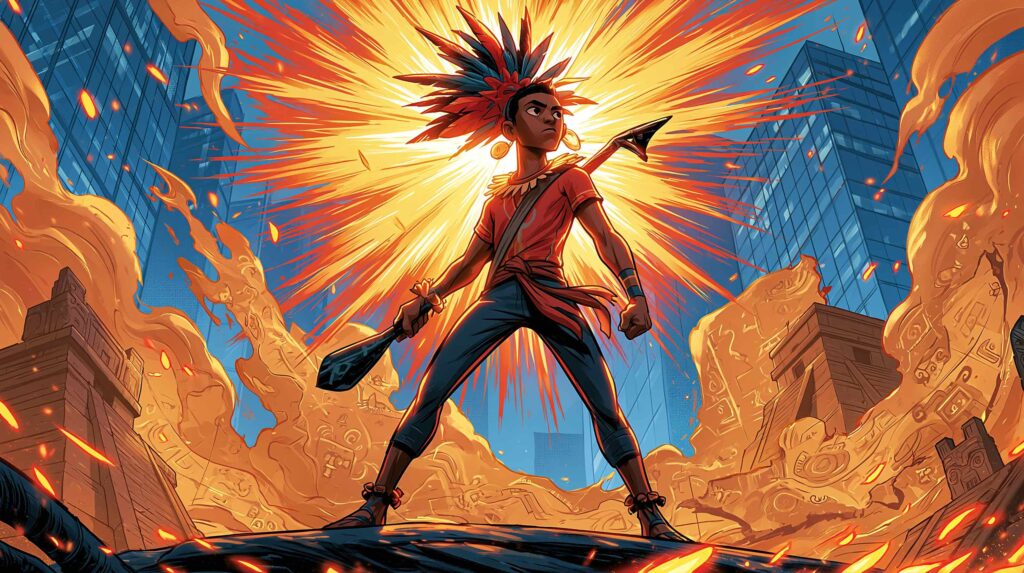
The final archetype is the most extreme case study ancient civilization ever encoded in divine form.
Huitzilopochtli. Aztec god of the sun and of war. His name translates as “Hummingbird of the South” which sounds pastoral and soft until you understand the source material. In Aztec warrior culture, hummingbirds were the reincarnated souls of fallen soldiers. Not metaphorically. Literally. Every hummingbird you encountered in a field was understood to be a warrior who had died in service of the mission, returned in the smallest possible living form, still in flight, still moving, still feeding.
When the Aztecs named their supreme deity after one, they were making a theological claim about purpose: even after death, even in the smallest form, the mission continues.
That is the most serious relationship with purpose I have ever encountered in any civilization’s mythology.
The Central Myth and Its Organizational Translation
Huitzilopochtli’s core myth operates on genuinely existential stakes: every single day, the sun must fight its way across the sky against the forces of darkness. Every dawn is a hard-won victory. Every night is a genuine crisis. And the Aztec people believed structurally, institutionally that if they stopped sustaining the mission, the sun would not rise.
The organizational translation is visceral.
Teams that do not understand why they exist will not survive their dark hours. And every team, in every industry, in every company, has dark hours. The failed launch. The competitor that comes from nowhere and takes your flagship product’s market position in a single quarter. The investor meeting that goes wrong at the worst possible moment. In those hours, the only thing that actually pulls people forward is purpose so deep it functions like a survival instinct rather than a line in a strategy document.
SpaceX survives its catastrophic failures rockets exploding on launchpads, hundreds of millions of dollars evaporating in sixty seconds because the people there are not working for a paycheck and a stock option. They are working on the continuation of human civilization. That is not a culture initiative. That is Huitzilopochtli. The mission is the sun. The work is what keeps it rising.
The Uncommon Connection: Telos vs. Mission Capture
Aristotle’s concept of Telos the purposeful end toward which something exists is the philosophical backbone of what Huitzilopochtli represents. In Aristotelian thinking, everything has a Telos: an inherent direction of fulfillment. A knife’s Telos is to cut. An organization’s Telos is to fulfill a specific human need in the world.
But there’s a corruption that can enter: mission capture the moment the mission becomes more important than the people who carry it. This is where the Huitzilopochtli archetype turns from its most powerful form to its most dangerous.
The Aztec priests who administered Huitzilopochtli’s rituals eventually reached a point documented in pre-conquest Aztec accounts where the volume of sacrifice required to “sustain the sun” was self-defeating. The mission had consumed the civilization’s capacity to fulfill the mission.
Adam Neumann at WeWork had a vision of human community that was, at its core, genuine. The idea of co-working spaces as a platform for serendipitous human connection that’s a real insight about how modern work could be better. But the zealotry of that vision, scaled without the proportional growth of human care for the people executing it, produced a culture where employees were expected to sacrifice their wellbeing for a mission whose execution increasingly resembled theater rather than substance. The sun was supposed to rise. The warriors were consumed.
The zealot who forgets his people are human is not a leader. He is a furnace.
The Leadership Parallel: Feed the Mission, Never Consume the Team
Missionary leadership the genuine belief that the work matters beyond its transactional value is the most powerful leadership force available to any organization. It creates discretionary effort that no performance management system can generate. It builds resilience in conditions that would dissolve a mercenary team.
But it carries a specific ethical responsibility: the mission is for the people, not the other way around. The moment the logic inverts when the people exist to serve the mission rather than the mission existing to serve something human you’ve crossed from leadership into extraction.
Actionable diagnostic: When did you last adjust the mission’s demands to accommodate the team’s human reality? If the answer is “that’s not how we think about it,” you may be running a very small, very motivated furnace.
The Unified Diagnosis: Seven Gods, One Developmental Arc
Seven archetypes. Five civilizations. One consistent pattern, encoded across thousands of years of independent mythological tradition, that describes the complete developmental arc of genuine leadership.
Hercules is the entry point. Every leader begins here as the most capable individual in the room. The transition out of Hercules is the first and hardest threshold of the entire journey.
Rama is the first philosophical evolution from personal capability to systemic service. The shift from “what can I produce” to “what can I create the conditions for others to produce.”
Odin represents the second threshold strategic maturity. The willingness to sacrifice a current advantage for future clarity. The organizations that can pay this price survive paradigm shifts. The ones that can’t become the cautionary case studies.
Shango is the founding energy that every organization needs and eventually needs to outgrow. The thunder that builds culture must eventually learn to become weather. Leaders who make this transition become architects of institutions. Leaders who don’t become legends told at acquisition announcements.
Itzamná is the often-skipped archetype the one that doesn’t make for a compelling TED talk but whose absence creates the most consistently expensive organizational failure mode. Build the codex. Preserve the intelligence. Compound the learning.
Murugan is the competitive philosophy. Compete fiercely, in every direction, with full situational awareness, and with methods clean enough that your reputation compounds rather than corrodes. In the right market, honor is the ultimate moat.
Huitzilopochtli is the highest and most dangerous expression: purpose so deep it functions like physiology. The missionary commitment that outlasts setbacks, absorbs catastrophes, and drives the work forward when every rational signal says stop. The obligation is to carry the fire without burning the people who carry it with you.
The Lone Genius fallacy isn’t a leadership philosophy. It’s an origin story. Every great leader began as the most capable individual in the room. The arc from Hercules to Huitzilopochtli is not automatic. It is chosen, labor by labor, sacrifice by sacrifice, codex by codex.
Your assignment: identify which archetype you are currently inhabiting. Not the one you aspire to. Not the one you’d put in a keynote bio. The one you actually are, today, in the decisions you made this week.
The gap between those two archetypes is your entire leadership development agenda.
The myths have been patient. They’ve been waiting for millennia. They can wait until you’re ready.
Watch Next: Going Deeper Into the Myth
The seven archetypes in this post represent the leadership dimension of a much larger set of mythological parallels being explored across this series.
If Odin’s sacrifice and the price of technological foresight resonated with you the next natural progression is the AI-Prometheus Parallel, which examines how the myth of Prometheus (fire stolen from the gods, given to humans, at catastrophic personal cost) mirrors the current trajectory of artificial intelligence development. The same pattern of a powerful intelligence gift, given without adequate preparation, producing simultaneously liberating and dangerous consequences, is encoded in Greek myth with unsettling specificity. We go through Bostrom, Tegmark, and the EU AI Act alongside the myth. It’s a different kind of uncomfortable.
If Shango’s thunder and the question of conviction-versus-control resonated the Trickster Gods episode maps the organizational archetype of the productive disruptor: Loki, Sun Wukong, Anansi, Maui, Eshu, Raven, and Narada, examined as a unified archetype of the insider-outsider who reveals what the institution cannot see about itself. Every organization needs one. Almost none of them know how to keep one without eventually destroying the relationship.
If Itzamná and the question of institutional knowledge left you uncomfortable about your own organization the episode on ancient persuasion examines how civilizations from Mesopotamia to Tang Dynasty China developed systematic frameworks for communication, rhetoric, and influence that predate Aristotle’s Rhetoric and have never been properly integrated into modern organizational communication theory.
The myths are layered. Pull any thread and you find another beneath it.
Mythos & Mortals bridge the gap between ancient mythology and the modern professional world. We believe that today’s “modern” problems, toxic office politics, high-stakes strategy, and emotional intelligence are actually ancient human patterns. By looking at how our ancestors encoded solutions into myth, we find the blueprints to overcome 21st-century challenges.